Google
 

Tuesday, October 2, 2007

SAP R/3

SAP R/3

SAP R/3 is a computer system that is designed to support complete business management tasks of a corporation, company or institution. SAP R/3 is used in business systems to handle invoice payment, production resource management and financial account control. These specific tasks are accomplished by employing application modules, often described with acronyms such as MM (materials management) and SD (sales and distribution).

Modules process information through each and every component of the organization, using one secure R/3 system to share relevant information between parts of the organization, keeping the corporation up-to-date on latest technology and data information. Modulation is customized to provide specific technical requirements of an organization. A common database is employed among each of the mid-sized to large-size corporations that utilize R/3. R/3 may also be used by small business, allowing business to prosper without having to worry about changing systems.

An additional benefit to using SAP R/3 is that it combines with a corporation’s previously existing computer system. R/3 uses the ABAP/4 programming language and allows for the possibility of several computers of differing manufacturers to conjoin into one solid working database, operating in the open system or client/server environments. SAP R/3 is a Windows and Menus driven application containing graphical objects.


Oracle Apps Flex fields

Oracle Apps 11i Tutorials : Oracle Flex fields

This chapter provides you with a conceptual overview of flexfields. The chapter covers the following topics The general features of flexfields, Flexfields terminology , The benefits of flexfields and Descriptive Flexfields.

Overview of Flexfields

Oracle flexfields is one of the most important parts of Oracle Applications. It is because of the flexfields that the Oracle Applications is so generic in nature and can be used to suit any industry or organization. A flexfield, as the name suggests, is a flexible data field that your organization can customize to your business needs without programming. A flexfield is a field made up of sub–fields, or segments. While flexfields do not require programming, they do allow you to perform significant customizations to the Oracle Applications, so they do require enough explanation for you to get the most out of the features they provide.

Oracle Applications uses two types of flexfields, key flexfields and descriptive flexfields. A key flexfield is a field you can customize to enter multi–segment values such as part numbers, account numbers, and so on. A descriptive flexfield is a field you customize to enter additional information for which your Oracle Applications product has not already provided a field.

Basic Business Needs

Oracle Applications flexfields let you satisfy the following business needs:

  • Have “intelligent fields”—fields comprised of one or more segments, where each segment has both a value and a meaning.
  • Rely upon your application to validate the values or the combination of values that you enter in intelligent fields.
  • Have the structure of an intelligent field change depending on data in your application.
  • Capture additional information if you so choose.
  • Customize data fields to your meet your business needs without programming.
  • Query intelligent fields for very specific information.

Key Flexfields

key flexfield is a field made up of segments, where each segment has both a value and a meaning. You can think of a key flexfield as an “intelligent” field that your business can use to store information represented as “codes.”

Most organizations use ”codes” made up of meaningful segments to identify general ledger accounts, part numbers, and other business entities. Each segment of the code can represent a characteristic of the entity. For example, consider an account number for a bank. A complete bank number may consists of various segments like the country code, area code, city code, branch code, account type, account number etc.

Bank Number : [01].[002].[08].[S].[124467]


Country Code City Code Branch Code Account Type(Savings/Current) Account #

The number of segments a bank requires to identify an account number uniquely is a requirement specific to the bank. Another bank might not require a country code if its presence is there only in one country. Key flexfields are used to identify such information uniquely.

A key flexfield is flexible enough to let you use any code scheme you want to describe an entity. When your organization initially installs an Oracle Applications product, your organization’s implementation team customizes all the key flexfields in that product to use meaningful code segments to describe each key flexfield entity. Your organization decides for each key flexfield, how many segments an entity has, what each segment means, what values each segment can have, and what each segment value means.

Your organization can also define rules that govern what combination of segment values are valid (cross–validation rules), or define dependencies among the segments. The result is that your organization can use the codes it needs rather than change its codes to meet someone else’s requirements.

The Accounting Flexfield in your Oracle Purchasing application is an example of a key flexfield that identifies a unique chart of accounts. One organization may choose to customize the Accounting Flexfield to have three segments called Company, Department, and Account, while another organization may choose to customize the flexfield to have five segments called Company, Cost Center, Account, Sub–Account, and Product.

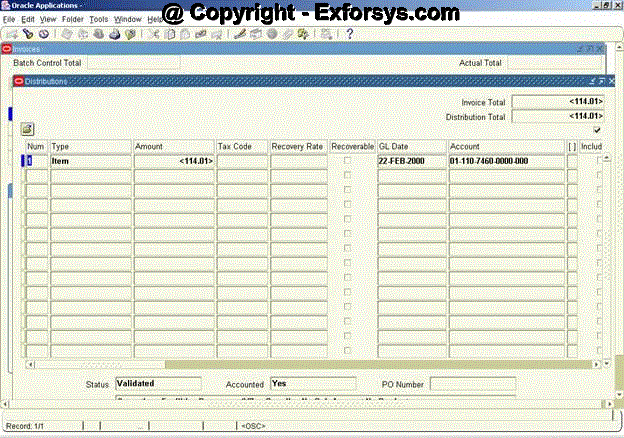
A key flexfield appears on your form as a normal text field with an appropriate prompt. In figure 1 below, the Account field is actually the Accounting Key Flexfield.

Figure 1. Key Flexfield in a form

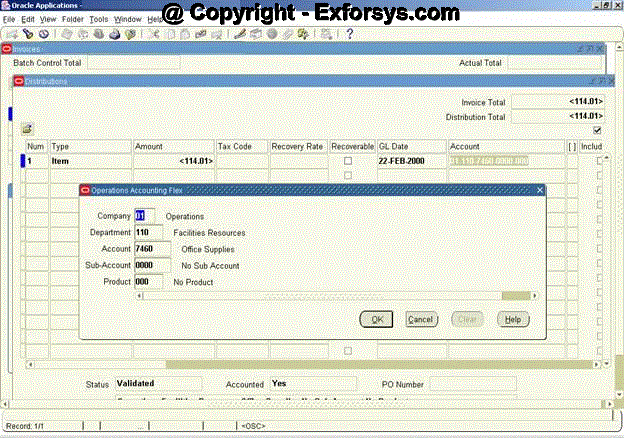
A window pops-up when you navigate to the key flexfield as shown in figure 2 and it would require you to enter the various segments defined for the key flexfield.

Figure 2. Key Flexfield Pop-up


Certification

Certification

SCJP Tutorials

The Sun Certified Java Programmer (SCJP) tutorials in this section provide IT professional interested in getting certified as SCJP. The SCJP certification process is a prerequisite to other Java-related software certification processes and is a valuable skill that any computer sciences professional should attain. The SCJP exam is an entry-level test, designed to secure that a developer has a working knowledge of the Java programming language.

SCJP tutorials encompass the basics of the Java programming language that will be examined in the SCJP certification process such as declarations, initialization, scoping, flow control, API contents, collections and generics. All of these areas of the SCJP tutorials provide thorough details and explanations of each including sample code to assist the programmer in learning about the Java language.

SCJP certification process includes a multiple-choice exam consisting of 72 questions that a potential certification holder will have to complete in a 175-minute time restraint. Using the tutorials as a study guide, the programmer or developer will be given tips, tricks and valuable information geared toward enabling the IT professional to pass the SCJP examination. Sun Microsystems, Inc. has created a test that focuses on writing code and examining a developer’s performance under pressure, rather than testing a series of memorized details.

  • Microsoft Certification

    Information Technology professionals are required to familiarize themselves with a wide range of software development technologies and information systems in order to succeed in today’s competitive, modern world. One of the primary technologies that any serious IT professional will want to learn is the complete series of Microsoft products. Microsoft Certification is a necessary process that individuals in the computer sciences will have to undergo.

    Courses on Microsoft certification are administered throughout the world at specialized Microsoft centers and accredited colleges and universities. The information provided in this section will assist any IT professional in becoming familiar with Microsoft software and investigating career options in Microsoft products and development. Elective material and core topics are covered in this section in helpful tutorials, exam preparation, basic overviews and specific certification requirements.

    Certification in the Microsoft line of software includes CRM Installation and Configuration v. 1.2, CRM Customization and CRM Professional Applications. When an IT professional completes the Microsoft Certification process, the individual programmer who passes specific exams can become a Microsoft Certified Professional (MCP), Microsoft Certified Systems Engineer (MCSE), Microsoft Certified Solution Developer (MCSD), Microsoft Certified Database Administrator (MCDBA), Microsoft Certified Trainer (MCT) or a Microsoft Office User Specialist (MOUS).

  • SCBCD ( 36 Articles )

    SCBCD

    SCBCD or Sun Certified Business Component Developer for the Java 2 Platform, Enterprise Edition (J2EE) is a position that is attained through a certification process which allows an Information Technologies professional to achieve a valuable title that will assist him in advancing his career. SCBCD is a specialized area of the development process that focuses on information connected to Java components associated with distributed applications, in particular, Enterprise Java Beans (EJBs). In order to become certified in SCBCD, a candidate must fulfill and pass a computer-based exam.

    An IT professional interested in attaining a SCBCD certification must first fulfill the prerequisite Java 2 Platform (any edition) certification process before attempting to become certified in SCBCD. Programmers and developers who have a keen interest in integrating EJBs applications as well as developing, testing, designing and deploying EJB applications should study for this exam. The series of SCBCD articles and tutorials on this website will help the IT professional prepare for this exam through complete study notes that cover all areas of the SCBCD platform.

    The Sun Certified Business Component Developer program includes technologies that are relevant to those individuals familiar with leveraging J2EE platform who are interested in developing server-side components that summarize the business logic of an application.

  • Oracle Certification ( 2 Articles )
  • Sun Certification ( 17 Articles )

    Sun Certification

    Sun Microsystems, Inc. developed innovative technologies such as the Java platform, J2EE and the Solaris Operating Environment. The certification system from Sun includes software that any professional in Information Technology will have a keen interest in familiarizing with, in order to become a well-rounded professional.

    The articles in this section will guide the IT professional in accomplishing a full range of high quality certification programs in Sun Microsystems’ groundbreaking technologies. Sun Microsystems information technology includes open source software and products including SPARC and AMD’s Opteron processors, software products and storage systems. Sun Microsystems is one of the primary leaders in Web infrastructure software, identity management applications and essential developer tools.

    A developer seeking to certify in software development systems will want to study and practice in their specialized area of interest. Free Exam Simulators are available to download in Java, Java Web Services, Java 2 Platform, Solaris 8 and 9 Operating Environments and J2EE. It is advisable to learn and examine these programs in order to achieve higher status in his area of interest.

  • Certification Articles ( 30 Articles )

    Certification Articles

    An information technology professional is required to participate in various certification processes that will allow the IT professional to attain status, education and clout in his field of specialization. Certification Articles in this section will benefit professionals who are interested in advancing their career through specialized knowledge and expertise by getting certified. Becoming certified is a time consuming process for serious computer sciences professional. Familiarizing oneself with all the relevant information pertaining to IT certification can make the certification process easier to handle.

    Your area of interest in information technologies may reside in the Internet, operating systems, professional development, databases, telecommunications, security, graphics, web development, desktop publishing, programming languages, fiber optics, networking or graphics, the certification articles in this series of tutorials will form an essential resource for the IT professionals and aspiring candidates to educate themselves with valuable information.

    Basic reviews of PC skills, office and desktop applications are included in the informative tutorials under certification articles series. Comprehensive information on certification in many areas of information technologies and computer sciences will provide the IT professional with proper accreditations to succeed in varying sectors and the field of his choice.

Copywriting Questions - The World of Online Copywriting

Copywriting Questions - The World of Online Copywriting

Online copywriting has become a multi-billion dollar resource for companies that utilize the internet. There are ads, publications, banners, websites and articles that are written by freelance copywriters through the internet. Copywriting persuades or draws attention to whatever is being promoted. Good online copywriting invites a person to actually read the ad whereas bad copywriting can quickly be navigated away from.

The internet has turned into a billion dollar revenue source for thousands and thousands of companies throughout the world. Online copywriting is more often associated with a form of article called a Search Engine Optimized (SEO) article. The SEO copywriter writes articles, varying in lengths, to fit a series of keywords or phrases that will turn up prominently in an internet search through such search engines as Google or Yahoo.

The web copywriter must be internet savvy. Often links are used within the article that will direct the reader to an additional webpage. Online copywriting is a valuable tool used by companies who want to reach a wider demographic audience. Many website articles are tailored to meet the demands the customers are expecting and as a way to draw potential visitors in, the web copywriter must have online copywriting articles that are suited to that audience.

Words have power. We see that day in and day out through the commercials and ads we see each day. But one form of online copywriting we do not often take into consideration when thinking about copywriting in general is that essays or reviews against a particular subject are considered a form of marketing. Take for example the government and organization ads against smoking. The articles and commercials are very much against use of any form of tobacco. Their use of health statistics show the detrimental effects that smoking has on our bodies, not only as a tobacco user, but through second hand smoke as well.

As more people turn to the internet for personal enjoyment, shopping and to stay informed, online copywriting will continue to be a formidable force to be reckoned with. Jobs will be created and the opportunities to advance in this career field will continue to rise. If you find yourself intrigued by the idea of being a copywriter, it is definitely worth checking into.

Microsoft CRM

Microsoft CRM

Microsoft Customer Relationship Management (Microsoft CRM) is a software package that is part of the Microsoft Dynamics family of business tools. Microsoft CRM provides business solutions that allow the user to synchronize with email programs such as Microsoft Outlook and integrate with personal mobile devices such as the BlackBerry.

In this Tech articles section, Microsoft CRM fully functional and interactive demo is provided for the serious information technology professional. The Microsoft CRM demo can be utilized for computer sciences professionals in customer service, marketing and sales. Microsoft CRM software integrates business productivity, performance, a strong development environment and support of Microsoft Windows Server TM 2003, Microsoft Exchange Server 2003, Microsoft Office 2003, and Microsoft Small Business Server.

The short (5-7 minute) demos provide the programmer and developer with information about sales review and service functionality. Using Microsoft CRM technology, an individual can improve upon security, scalability, availability and the reliability that businesses require from servers, operating systems and productivity tools. This demo will assist the IT professional in keeping updated with the latest breakthroughs and developments in Microsoft CRM. Reporting capabilities, customizable workflow processes, reducing support costs and managing support incidents are discussed in a thorough overview to provide the developer with all relevant CRM information for important business solutions.